
Begin with the instrument, not the headline
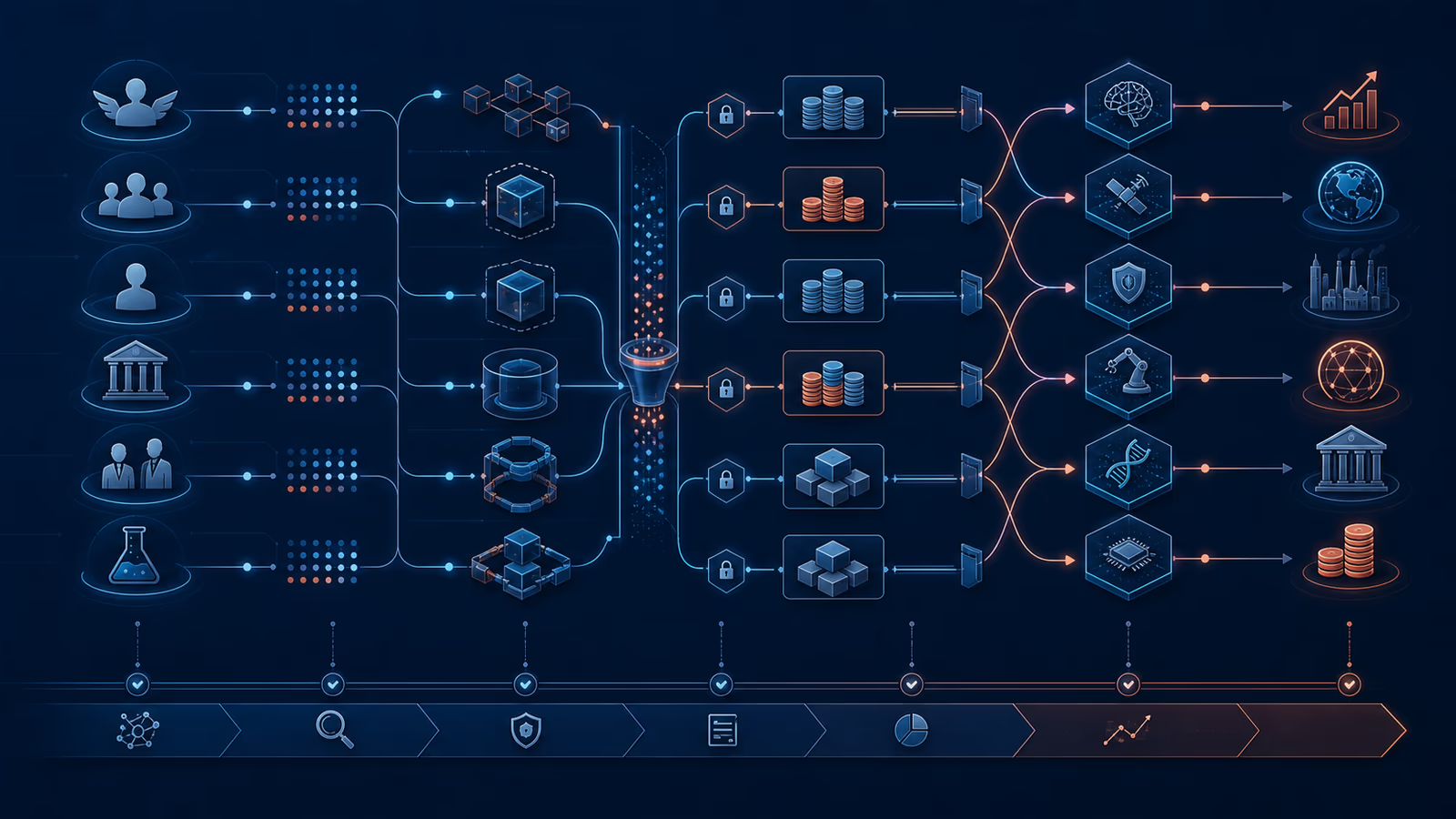
Israeli startup investing is often discussed through company stories: a cyber breakout, a defense technology pilot, a semiconductor team, a medical AI system, a repeat founder, or a famous fund. The actual exposure comes through an instrument and a legal relationship. A direct check, a SAFE, a convertible note, a preferred share round, an SPV interest, a venture fund commitment, a secondary purchase, a public security, and a corporate design partnership all behave differently. They differ in information rights, liquidity, fees, control, tax reporting, follow-on rights, transfer restrictions, and downside protection. Readers should understand what they are buying before deciding whether the company story is attractive.
That order matters because private-market access can create a false sense of progress. A warm introduction or allocation tells you that a route exists. It does not tell you that the terms are fair, the company is strong, the lead has edge, or the exposure fits your portfolio. In early-stage Israeli technology, the information gap can be large: customers may be confidential, defense users may be sensitive, pilots may be informal, revenue may be lumpy, and strategic claims may be difficult to verify from public sources. The structure of the investment determines how much of that uncertainty you can monitor after closing.
A fund commitment shifts selection to a manager, spreads exposure across a portfolio, and usually locks capital for years. A single-company SPV may provide access to a specific deal, but it can add fees while leaving investors dependent on the sponsor's updates. A direct investment can improve visibility if the investor has real access, but it also concentrates risk and requires follow-on planning. Public-market exposure is liquid, but it may be many steps removed from startup formation. Strategic partnerships can generate operational learning before equity risk, but pilots can become unfunded custom work if success criteria are vague.

Mechanisms
The same company can look different through each mechanism. A strong startup may be unattractive at an inflated valuation, through a fee-heavy SPV, without information rights, or without the ability to protect ownership in later rounds. A less glamorous fund may be attractive if the manager has disciplined access, coherent reserves, clear reporting, and realistic loss analysis. A public company may be useful for theme research but inappropriate as a proxy for private startup upside. The mechanism sets the practical risk even before the sector view begins.
For cross-border readers, operating complexity is not a footnote. Eligibility, accreditation, tax treatment, foreign exchange, custody, KYC, AML, sanctions screening, entity formation, and local offering rules can control whether participation is available at all. In dual-use, defense-adjacent, cyber, AI, health, and data-heavy categories, compliance review can also touch export controls, data transfer, procurement restrictions, customer restrictions, and reputational limits. The correct answer is often not to avoid the category; it is to know when a professional adviser needs to be in the loop before terms, signatures, data rooms, or customer introductions move forward.
- Direct angel investing means buying exposure to a specific private company, usually with limited liquidity and limited information.
- Syndicates and SPVs pool investors around a single deal, usually led by someone with access or underwriting responsibility.
- Israeli VC funds provide diversified exposure through a manager, but introduce manager selection, fees, blind-pool risk, and long time horizons.
- Strategic investment and corporate partnerships can combine capital with pilots, distribution, integration, or government-market access.
- Public-market exposure can be liquid, but it is not the same as private startup access and may not provide pure thematic exposure.
- Equity crowdfunding and online platforms can expand access, but platform availability, investor eligibility, fees, disclosure, and selection quality vary.
- Government and non-dilutive funding can extend runway or validate technical priorities, but it does not prove commercial demand.
Three different questions
A reader can learn about a company without having access to the round. A reader can have access without the investment being suitable. A reader can find a suitable route but still pass because the price, evidence, or follow-on plan is weak. Keeping those questions separate reduces pressure from scarcity language. It also makes diligence more honest: the goal is not to justify participation, but to identify what evidence would change the decision.
Learning about a company: understanding what it does, where it sits, and what evidence exists.
Getting access to a round: having a legal and practical route to invest on specific terms.
Making a suitable investment: determining whether the investment fits your objectives, risk tolerance, legal constraints, tax situation, and portfolio.
Access is not suitability
Access means you can legally and practically participate in a route. Suitability means the exposure fits your objectives, risk tolerance, liquidity needs, legal eligibility, tax position, portfolio construction, and adviser review. Claw & Talon can help frame research questions, but the suitability decision happens outside the site.
Allocation quality also matters. An allocation can be available because a company is excellent, because the lead has strong access, because insiders are full, or because more informed investors passed. Investors should ask why this access exists and what information rights come with it.
Allocation quality and adverse selection
Allocation is a signal, but it is an ambiguous one. It can mean the lead has exceptional access, the company wants a strategic investor, insiders are making room for a useful participant, or the round needs more demand than expected. In hot categories, scarcity can be manufactured by speed and social proof. In difficult categories, access can be abundant because better-informed capital is cautious. Investors should ask who declined, who is leading, how much insiders are taking, what rights attach to the allocation, and what reporting will exist if the company misses the next milestone.
- Who is leading or sponsoring the opportunity, and what do they know that followers do not?
- How did the allocation become available?
- Are insiders participating, and on what terms?
- What information rights, reporting, and follow-on rights exist?
- Could the opportunity be available because higher-quality investors declined?
Follow-on rights, reserves, and information rights
Early private-company exposure is not only about the first check. Investors need to understand whether they can participate in future rounds, whether they have capital reserves, whether the lead or manager handles follow-on, and what information will be available between financings.
Weak information rights, no reserves, or unclear pro rata can turn a promising company into a difficult portfolio-management problem even when the product improves.
This is especially important in Israeli technology categories where later rounds may involve foreign investors, strategic corporates, defense primes, sovereign constraints, or customers that care about control and data access. A company can need capital quickly after technical validation because deployment, certification, inventory, security review, or U.S. go-to-market costs arrive before revenue scales. If the first investor cannot follow, cannot receive timely information, or cannot evaluate new terms, early ownership can be diluted or trapped in a structure the investor did not understand at entry.
A practical decision sequence
A disciplined workflow starts with the reader's role. A beginner should learn vocabulary and avoid live deals until the risk model is clear. An angel should define check size, loss tolerance, reserve policy, information requirements, and sector boundaries before seeing a deck. A family office should decide whether it wants direct exposure, manager exposure, strategic learning, or research support. A corporate team should separate pilot value from investment value. A public-market investor should avoid treating a listed Israeli technology company as a private startup substitute.
Once the role is clear, the next question is evidence. What customer proof exists? What must integrate? Who pays? What does the cap table imply for the next round? What compliance surface exists? What would make the company fail even if the technology works? Only after those questions are answered does valuation become meaningful. Price is not cheap or expensive in isolation; it is cheap or expensive relative to evidence, rights, dilution risk, exit paths, and the capital still required to prove the business.
Valuation discipline and outside review
- Compare valuation to evidence, not category heat.
- Review tax, FX, legal eligibility, KYC/AML, sanctions, and compliance questions with qualified advisers.
- For dual-use and defense-adjacent companies, review export controls, end-user restrictions, data movement, and government-customer constraints.
- For public-market exposure, read filings and risk factors rather than treating the company as a startup proxy.
Risks that do not disappear
- Illiquidity
- Follow-on risk
- Information asymmetry
- Fund access
- Manager selection
- Concentration risk
- Valuation uncertainty
- Total-loss risk
Investor Pathways Comparison
| Pathway | Best for | What you are really buying | What to learn first | Main diligence questions | Main risks |
|---|---|---|---|---|---|
| Israeli VC fund | LPs seeking diversified exposure through a manager. | Manager judgment, access, reserve strategy, and portfolio construction. | Fund terms, manager selection, sector focus, DPI/TVPI, and follow-on reserves. | What is the manager edge, how is access sourced, and how are reserves handled? | Manager selection, fees, blind-pool risk, J-curve, concentration, and illiquidity. |
| Direct startup investment | Experienced angels or strategic investors with access and diligence capacity. | A specific private-company risk profile. | Cap table, round dynamics, rights, valuation, customer evidence, and follow-on needs. | Why this company, why this price, why this round, and what evidence changes the view? | Total loss, information asymmetry, dilution, no liquidity, and weak rights. |
| Angel syndicate / SPV | Accredited investors learning through a lead while limiting process burden. | A deal selected by a lead, often with shared economics and limited control. | Lead quality, allocation source, fees/carry, information rights, and SPV governance. | What does the lead know that followers do not, and what happens after the round? | Adverse selection, high fees, thin rights, weak reserves, and uneven reporting. |
| Strategic partnership or investment | Corporates, family offices, or institutions with operational assets. | Access to capability, optionality, market learning, and sometimes equity upside. | Pilot design, integration burden, procurement path, conflicts, and commercial independence. | Can the startup win without us, and can we help without distorting it? | Pilot purgatory, strategic overhang, exclusivity friction, and slow decision cycles. |
| Public-market exposure | Investors who need liquidity and cannot access private rounds. | Listed-company exposure to Israeli or Israel-linked technology themes. | Public filings, revenue mix, valuation, liquidity, index exposure, and geopolitical sensitivity. | Is the exposure really Israeli startup formation, or a mature global technology company? | Market volatility, limited thematic purity, valuation compression, and public-company execution risk. |
| Corporate pilot / design partnership | Operators evaluating a technology before investment or procurement. | Evidence, workflow learning, and influence on product direction. | Success criteria, data access, support needs, security review, and deployment owner. | What must be true for pilot success to become paid adoption? | Unfunded pilots, unclear buyer, custom work, integration delays, and procurement mismatch. |
| Dual-use / defense strategic exposure | Strategic capital, defense investors, and mission owners. | Capability relevance plus commercial or procurement optionality. | Mission owner, field validation, export controls, classified constraints, and sustainment burden. | Is this real dual-use capability or defense-adjacent branding? | Procurement delay, export limits, customer concentration, support load, and reputational risk. |