
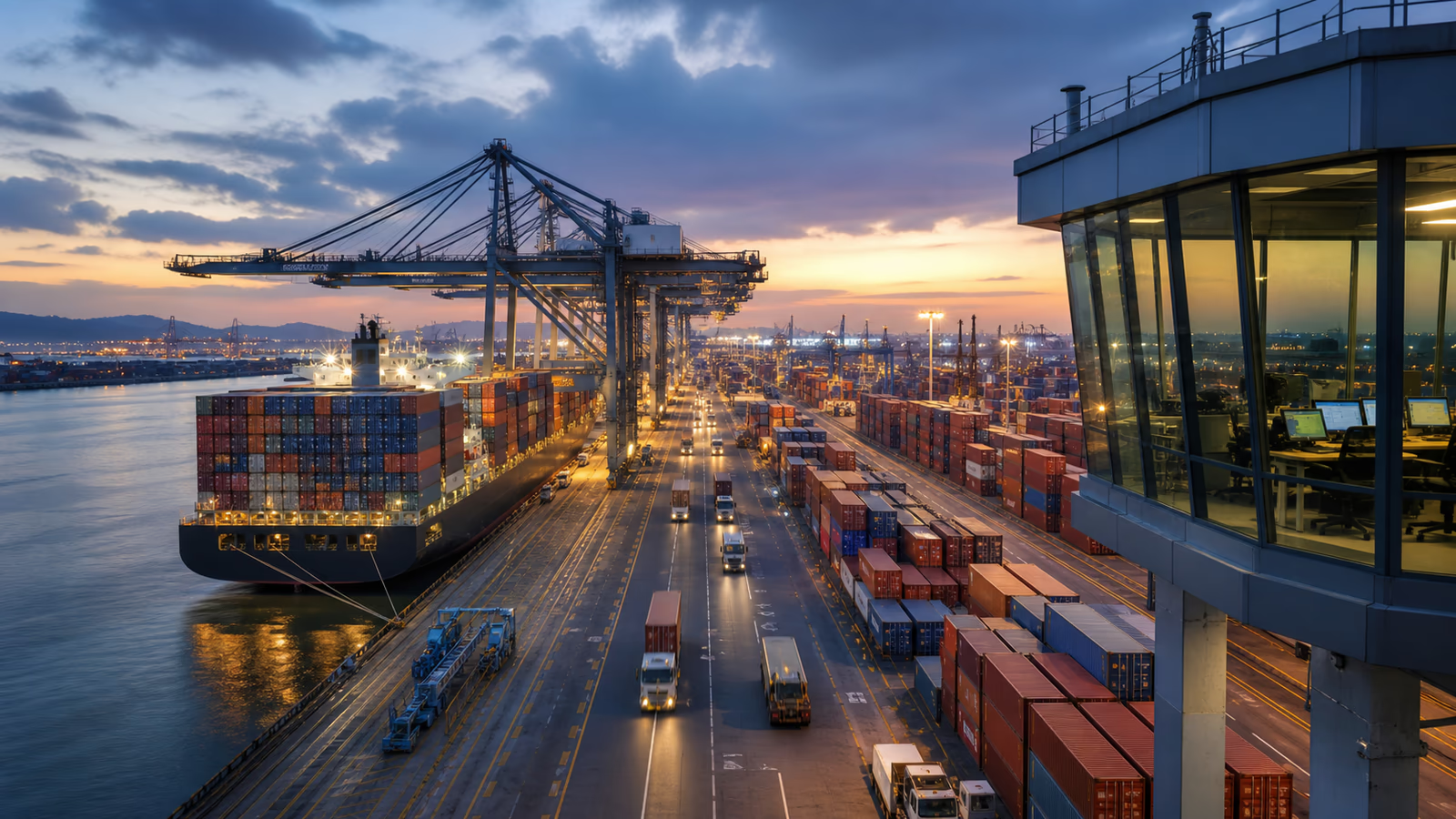
Shipping looks invisible right up until the route breaks. Then everyone rediscovers that ports, canals, insurance, freight intelligence, and customs systems are not background infrastructure. They are what make the economy move.
For Israel, maritime resilience is not a logistics footnote. It is a strategic requirement. When the Red Sea becomes dangerous or a chokepoint slows down, the impact spreads far beyond shipping companies. Lead times stretch, inventories thin out, input costs rise, and the whole economy starts carrying more uncertainty.
That makes port modernization, routing software, inventory planning, customs digitization, and alternate corridor coordination worthy of capital. These investments do not remove geography, but they do make geography less punishing. They give importers, government agencies, and operators more time, better visibility, and more options.
What pressure is this solving?
This priority is driven by concrete points of dependency that are already visible in the atlas. The goal is not abstract independence. The goal is to remove the narrowest bottlenecks first, then build more room to operate when the system is under stress.
Bab el-Mandeb and Red Sea disruption risk
The Red Sea threat environment can sharply increase freight times, insurance costs, and delivery uncertainty for Israel-bound trade.
- Vulnerability
- 89
- Importance
- 86
- Category
- Shipping & Chokepoints
Suez Canal access
Israel’s trade with Europe and Asia remains materially exposed to Suez throughput and Egyptian control over the canal.
- Vulnerability
- 84
- Importance
- 93
- Category
- Shipping & Chokepoints
Maritime vessels and floating structures imports
Maritime vessels and floating structures support port work, offshore infrastructure, naval sustainment, and coastal continuity.
- Vulnerability
- 70
- Importance
- 82
- Category
- Shipping & Chokepoints
Maritime vessels and floating structures imports
Maritime vessels and floating structures support port work, offshore infrastructure, naval sustainment, and coastal continuity.
- Vulnerability
- 67
- Importance
- 75
- Category
- Shipping & Chokepoints
What should the capital actually fund?
A useful resilience investment thesis needs to be concrete. These are the moves the atlas points to for this theme.
- Modernize ports, customs, berth planning, container visibility, and rerouting coordination systems.
- Increase strategic inventories for chokepoint-sensitive food, pharma, fuel, electronics, and industrial inputs.
- Back logistics intelligence, war-risk insurance tools, inland distribution buffers, and contracted alternative freight corridors.
Why can this make money?
Investors sometimes miss this theme because it feels operational rather than futuristic. That is exactly why it can be attractive. Software for freight visibility, document flow, route planning, and inventory resilience solves expensive daily problems. Hardware and automation inside ports can also create long-lived infrastructure businesses with defensible positions.
There is export upside too. Many countries and companies are relearning the same lesson about chokepoints and fragile trade routes. Solutions built for Israel can be sold to any market that cares about continuity under stress.
How to use this case responsibly
Treat this page as an editorial bridge between the Dependency Atlas and company-level diligence. It identifies a strategic pressure point, explains why the pressure may create durable demand, and points to the kinds of capabilities that could reduce dependency. It does not rank securities, confirm current fundraising, endorse any company, or imply that a reader can access a specific allocation.
Before relying on the theme, check the cited dependency records, compare the suggested actions with current procurement and commercial demand, and separate companies with verified traction from companies that are only adjacent to the problem. The strongest opportunity is usually not the company with the loudest resilience language. It is the one with a clear buyer, defensible technical proof, reliable delivery economics, and a role that remains useful when the original scenario changes.
Use the score and rank as a starting point, then test whether the proposed capability would still matter if the dependency source, timing, or severity changed. A resilient thesis should survive more than one scenario and should be supported by sources that readers can inspect directly.
Bottom line
Maritime resilience is really trade continuity turned into a business category. Once you see it that way, the investment case becomes much easier to understand.